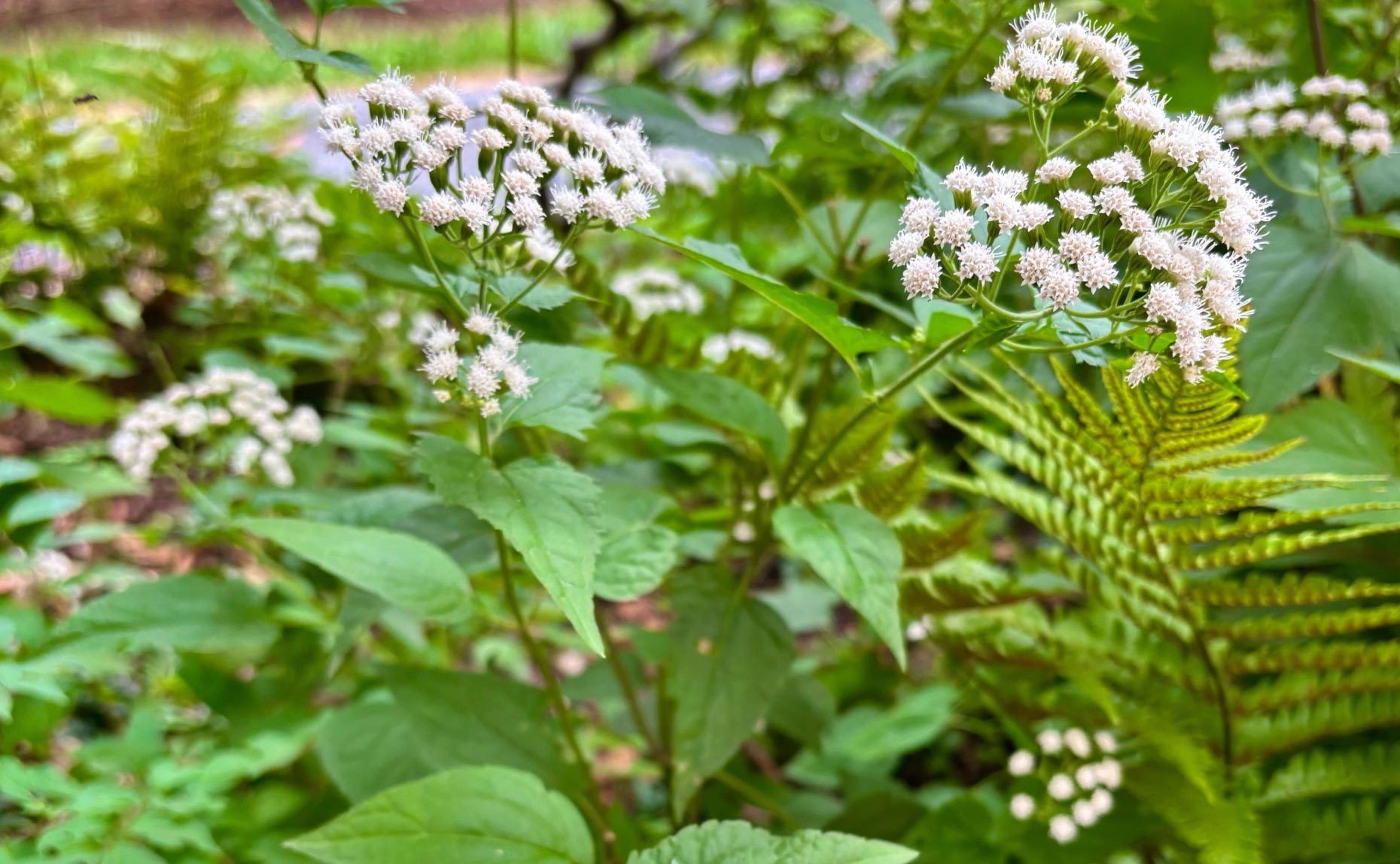
If you visit President Lincoln’s Cottage in late September or October, you may see groups of flowers with delicate white blooms tucked away in shaded areas. Though you’d likely walk right past, this plant once sparked a deadly mystery that haunted the American frontier and claimed the life of Nancy Hanks Lincoln.

White snakeroot with the Cottage in the background.
As settlers moved west during the start of the 19th century, a new and highly fatal disease began appearing in both livestock and humans. Farmers called it the “trembles” because animals infected with it would tremble upon any physical exertion. In humans, the “slows” as it was often called, began with vomiting, severe constipation, and fatigue and often progressed into a coma and ultimately death within a matter of days. It would also produce a distinct acetone-like odor in the breath of its victims. Eventually the disease became known as “milk sickness”.
Cases of milk sickness followed a pattern: they appeared most often near oak forests, rarely during winter, and peaked in summer and fall when grasses dried up. For already struggling frontier families, the mysterious affliction brought terror. Many even fled areas where it was particularly bad (half of all recorded deaths in Dubois County, Indiana in the early 19th century were attributed to milk sickness, for example).
The culprit? White snakeroot (Ageratina altissima). It is a common native herb in forests of the eastern half of North America. Livestock grazing in the woods ate the plant, and the poisonous compound in it would be passed into milk. But unfortunately for families on the frontier, acquiring this knowledge would take decades and cost thousands of lives.
One such frontier family was that of Thomas and Nancy Lincoln, who settled along Pigeon Creek in southern Indiana in 1816 with their two children. Mrs. Lincoln’s aunt and uncle settled nearby soon after. The family lived in a three-sided lean-to until a log cabin was completed a few months later.

A replica of the Lincoln family cabin in Indiana, photographed by Paula Alexander for the National Park Service.
In the fall of 1818, the “slows” swept through Pigeon Creek, claiming the lives of several neighbors of the Lincoln’s, including Nancy’s aunt and uncle. Nancy became ill after caring for some of the sick neighbors. Within two weeks of contracting the illness, on October 5, 1818, she too was gone. She left behind 9-year-old Abraham and 11-year-old Sarah.
It’s hard to believe the amount of time that would pass after Nancy Lincoln’s death before the mystery of milk sickness was solved. But progress continued, however slowly. Farmers began learning that if they fenced their livestock in pastures, incidence of the disease would be drastically reduced.
In the 1830’s frontier physician and midwife Anna Pierce Hobbs claimed that she had been informed by a Shawnee woman that the white snakeroot plant was poisonous. Dr. Hobbs spread the word to her neighbors and even grew a small plot of the plant so she could help others learn to identify it. It is unclear whether the direct correlation with milk sickness was ever made, however, and questions remain regarding the historical accuracy of the Anna Pierce Hobbs story.
In 1838, a farmer named John Rowe published an article in the local Washington, Ohio newspaper stating that white snakeroot was the cause of milk sickness, which he confirmed by feeding leaves to some of his cattle that became ill and died. His findings were largely ignored simply because he was a farmer. Prominent doctor Daniel Drake, who also had been investigating milk sickness for years, dismissed Rowe’s finding in The Western Journal of Medicine and Surgery: “A professional scrutiny only can be relied on in such cases. The testimony adduced by Mr. Rowe is therefore defective and inconclusive, even if nothing could be found to oppose it; but there are several facts which directly invalidate it.”
In 1840, W.J. Barbee of Marshall, Illinois published a thorough description of the disease and reported on research done by Dr. David Dale Owen who, after being tipped off by a farmer, gave a white snakeroot extract to a calf which died shortly after. Despite this publication, various other theories of the cause of the disease persisted, including “miasma” (or “bad air”), contaminated water, metallic poisoning, or plant poisoning. Eventually the plant poisoning theory was widely accepted, but researchers still had a variety of opinions as to which specific plant was causing milk sickness. In 1841, the legislature of Kentucky even offered a reward of $2,000 to anyone who discovered the cause of the disease.
The Ohio State Board of Agriculture released a report in 1858 linking white snakeroot directly to milk sickness. Over the second half of the 19th century, cases of milk sickness steadily declined, likely due both to growing medical awareness of the disease and to the shift toward more established farms, where livestock were less often allowed to forage in the woods.
It wasn’t until 1928 that USDA researcher J.F. Couch identified an alcohol in white snakeroot, which he named tremetol (to reflect its role in the “trembles”), that specifically caused the poisoning. At last, the mystery had been solved. The last reported human cases of milk sickness came in 1963 in St. Louis when two infants became infected. Both were successfully treated.
Today, thanks to modern dairy production and farming practices, white snakeroot is no longer a serious threat. In fact, it plays a valuable ecological role. Since it blooms long after most flowers have faded, it offers critical late-season food to native insects, particularly bees. It is also one of the rare native flowers that thrives in shade. It spreads aggressively by seed and underground rhizome, however, so it can quickly take over areas of gardens if not controlled.

A bee feeding on white snakeroot by the side of the Cottage.
At President Lincoln’s Cottage, white snakeroot still grows quietly in the shadows—a living reminder of the hardship that shaped Lincoln’s childhood. What once haunted frontier families now stands as a symbol of how far science and medicine have come, and how deeply our natural landscape is interwoven with history. Next time you visit, take a moment to notice the flowers along the path—you might just see the plant that forever altered the life of a nine-year-old boy named Abraham.
In this sad world of ours, sorrow comes to all; and, to the young, it comes with bitterest agony, because it takes them unawares.
-Abraham Lincoln, December 1862
Letter to Fanny McCullough (whose father died in the Civil War)
Sources:
Couch, J. F. (1938). Trembles (or milk sickness) [PDF]. Internet Archive.
Daly, W. J. (2006). The ‘Slows’: The torment of milk sickness on the Midwest frontier. Indiana Magazine of History, 102(1), 29–40. Retrieved from JSTOR
Frey, H., & Wilson, T. V. (Hosts). (2023, August 9). Milk sickness and the mystery of Dr. Anna [Audio podcast episode]. In Stuff You Missed in History Class. iHeartPodcasts.
National Park Service. (n.d.). Nancy Hanks Lincoln. U.S. Department of the Interior.
National Park Service. (2018). Abraham Lincoln’s boyhood in Indiana, 1816 to 1830.
Jordan, P. D. (1944). The death of Nancy Hanks Lincoln. Indiana Magazine of History, 40(2). Retrieved from JSTOR
Kentucky Legislative Research Commission. (n.d.). Moments in Kentucky legislative history: 7. Milk sickness (1841). Presented by the Kentucky Historical Society. Retrieved 9/9/2025, from Kentucky General Assembly website
Snively, W. D. Jr., & Furbee, L. (1966). Discoverer of the cause of milk sickness. JAMA, 196(12), 1055–1060. https://doi.org/10.1001/jama.1966.03100250065022